How Search Engines Work: Crawling, Indexing, and Ranking Explained

Every time you search on Google, you get thousands of results in seconds.

But have you ever wondered how search engines actually find and organize all that information?

Search engines follow a process to discover websites, understand their content, and decide which pages appear first in search results.

In this guide, you’ll learn how search engines work and how your content can become part of those results.

What Is a Search Engine?

A search engine is a tool that helps people find information on the internet.

Instead of visiting hundreds of websites, you can type a question or keyword and instantly get relevant results.

The most well-known example is Google, but other search engines include Bing, Yahoo, and DuckDuckGo.

Their main goal is simple:

to show users the most helpful and relevant content for their search.

The Three Main Steps of Search Engines

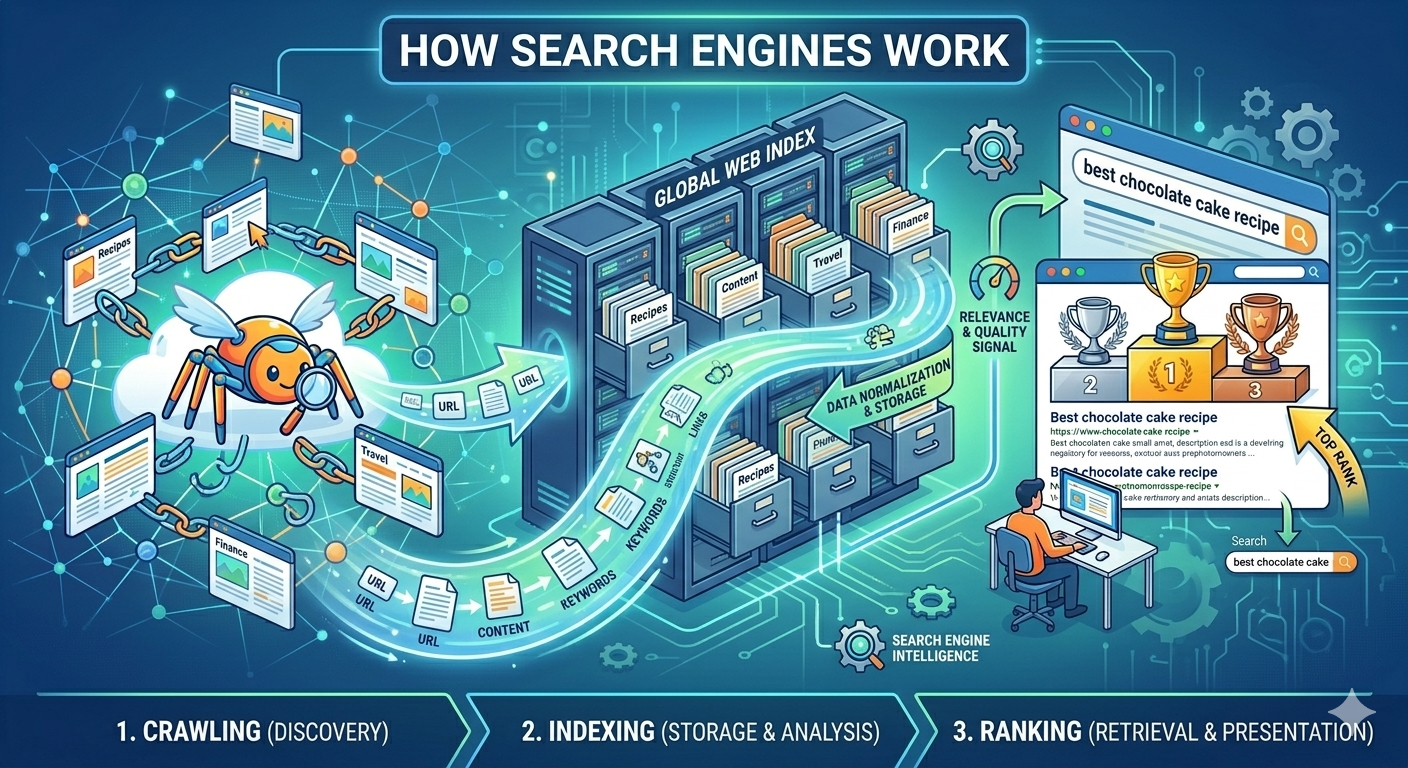
Search engines work through three main processes:

Crawling Indexing Ranking

These steps allow search engines to discover websites and decide which pages appear in search results.

1. Crawling: Discovering New Pages

Crawling is the first step.

Search engines use automated programs called bots or spiders to explore the internet. These bots move from one webpage to another by following links.

When they visit a page, they collect information such as:

Page content Images Links Page structure

If your website is new, it may take time for search engines to find it. However, internal links and sitemaps can help search engines discover your pages faster.
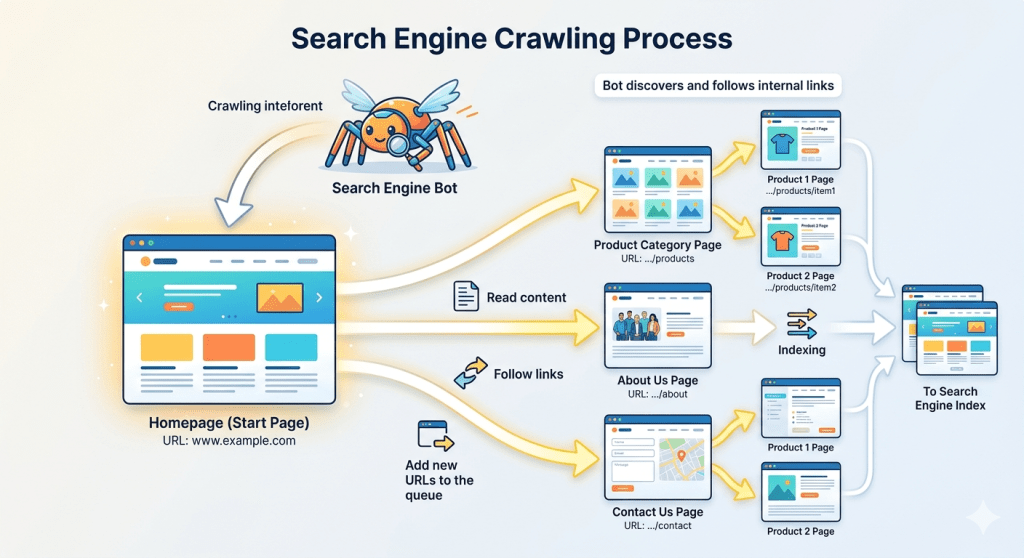

Search Engine Crawling Process

2. Indexing: Storing Information

After a page is crawled, the search engine tries to understand what the page is about.

This process is called indexing.

Search engines analyze the content and store it in a massive database called an index.

During indexing, search engines examine things like:

Keywords and topics Page titles and headings Images and alt text Content quality

If a page meets quality guidelines, it becomes eligible to appear in search results.

3. Ranking: Choosing the Best Results

Ranking is the final step.

When someone performs a search, the search engine scans its index and chooses the pages that best match the query.

Then it ranks them based on many factors, including:

Content relevance Website authority User experience Page speed Mobile friendliness

Pages that provide clear, helpful information are more likely to rank higher.
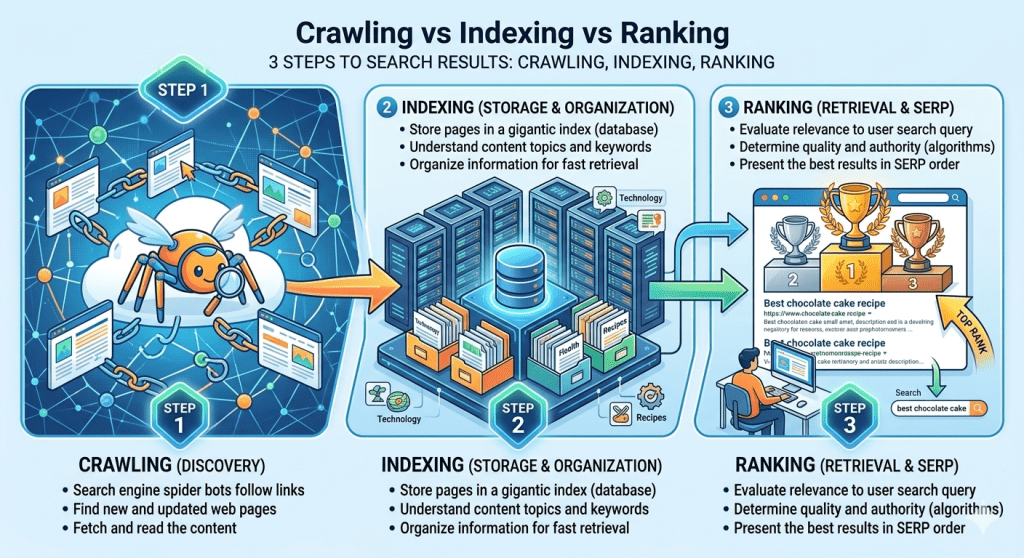

Crawling vs Indexing vs Ranking

Why SEO Matters

Search Engine Optimization (SEO) helps search engines understand your content.

When you optimize your website, you make it easier for search engines to crawl, index, and rank your pages.

Some basic SEO practices include:

Using clear keywords Writing helpful content Adding internal links Optimizing page titles and descriptions

These steps improve the chances of your content appearing in search results.

How Long Does It Take to Rank on Google?

SEO does not produce instant results.

New websites often need time before search engines trust them. It can take several weeks or even months for pages to rank.

Consistency matters.

Publishing useful content regularly helps search engines see your site as a reliable source of information.

Search engines may seem complex, but their goal is simple:

to connect users with the most useful content available online.

Understanding how crawling, indexing, and ranking work can help you create better content and improve your visibility in search results.

If you focus on clear, helpful information, search engines will have a much easier time discovering and ranking your pages.
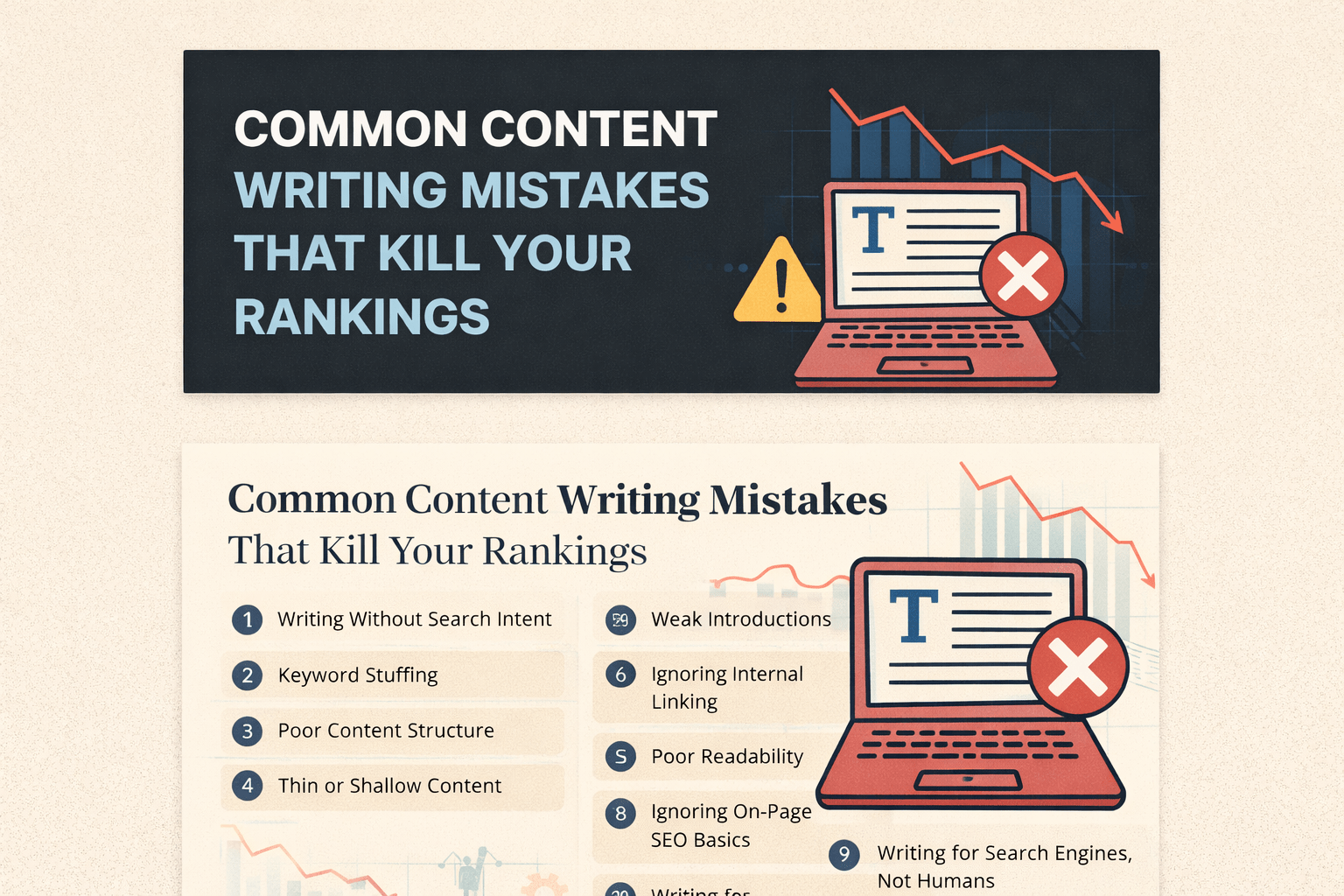
Common Content Writing Mistakes That Kill Your Rankings

Many writers believe that good writing alone is enough to rank on Google. In reality, even well-written content can disappear from search results if it ignores key SEO and content fundamentals.

In this article, we’ll break down the most common content writing mistakes that silently kill rankings—and how to fix them the smart way.

1. Writing Without Understanding Search Intent

One of the biggest SEO killers is writing content that doesn’t match what users are actually searching for.

For example, if someone searches for “content writing tips for beginners” and lands on an advanced marketing theory article, they will leave quickly—and Google notices.

How to fix it:

Analyze the top-ranking results Identify whether the intent is informational, commercial, or educational Write content that clearly satisfies that intent

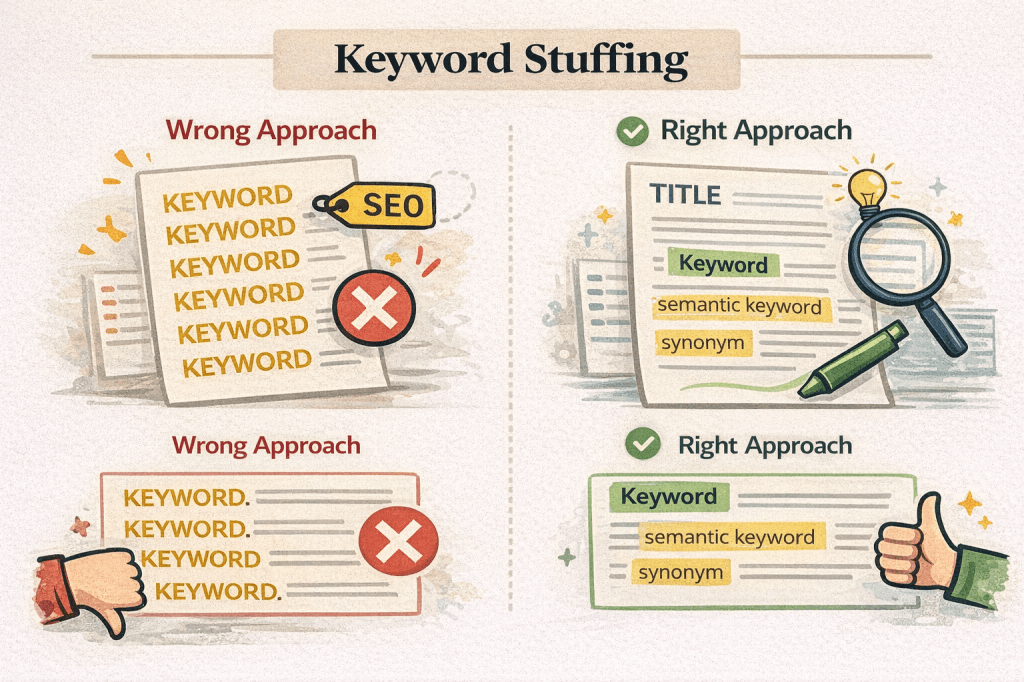
2. Keyword Stuffing Instead of Smart Placement

Using keywords too frequently makes content sound unnatural and can harm rankings.

Wrong approach:

Repeating the same keyword in every paragraph.

Right approach:

Use the main keyword naturally in: Title First paragraph Headings (where relevant) Add related and semantic keywords instead of repetition


Common Content Writing Mistakes That Kill Your Rankings

3. Poor Content Structure

Walls of text confuse readers and search engines.

If your article lacks clear headings, short paragraphs, and logical flow, users won’t stay long.

How to fix it:

Use clear H2 and H3 headings Keep paragraphs short (2–4 lines max) Use bullet points where appropriate

Good structure improves both readability and SEO.

4. Thin or Shallow Content

Short, generic articles with no real value rarely rank.

Google prioritizes content that demonstrates depth, clarity, and usefulness.

How to fix it:

Answer the topic completely Add explanations, examples, and practical advice Avoid rewriting what already exists without adding value

5. Weak Introductions That Don’t Hook the Reader

If the introduction fails, the article fails.

Users decide within seconds whether to stay or leave.

How to fix it:

Address the reader’s problem immediately Clearly state what they’ll gain from the article Avoid long, vague openings

6. Ignoring Internal Linking

Not linking to other relevant articles is a missed SEO opportunity.

Internal links help:

Search engines understand your site Users explore more content Pages rank better together

How to fix it:

Link naturally to related articles Use descriptive anchor text Avoid overlinking

7. Poor Readability

Long sentences, complex wording, and no spacing reduce engagement.

Even valuable content won’t rank if users struggle to read it.

How to fix it:

Write clearly and simply Use active voice Break long sentences into shorter ones

Readable content keeps users longer—and boosts rankings.

8. Ignoring On-Page SEO Basics

Many writers forget basic SEO elements.

Common mistakes:

Missing meta descriptions No optimized headings Images without alt text

How to fix it:

Write a compelling SEO title Add a clear meta description Optimize images and headings

9. Writing for Search Engines, Not Humans

Over-optimization makes content robotic and untrustworthy.

Google rewards content that feels natural and helpful.

How to fix it:

Write for people first Optimize second Focus on clarity and value

10. Never Updating Old Content

Outdated content slowly loses rankings.

Competitors update. Google notices.

How to fix it:

Refresh old articles every few months Update statistics and examples Improve structure and clarity

Ranking on Google isn’t about tricks or shortcuts. It’s about avoiding common mistakes and consistently creating helpful, well-structured, and user-focused content.

Strong rankings come from strong foundations—and content writing is one of them.

Content Writing vs Copywriting: What’s the Difference?

Many people use the terms content writing and copywriting interchangeably. While both involve writing, they serve very different purposes and require different skills.

If you’re a writer, marketer, or business owner, understanding the difference will help you choose the right path—and the right writer.

What Is Content Writing?

Content writing focuses on educating, informing, and building trust with the audience over time.

Common types of content writing:

Blog posts Articles SEO content Website pages Educational guides Email newsletters

Main goal:

To provide value and help the reader, while supporting long-term SEO growth.

Content writing is about relationships, not instant sales.

What Is Copywriting?

Copywriting is designed to persuade the reader to take immediate action.

Common types of copywriting:

Sales pages Ads (Google, Facebook, Instagram) Landing pages Product descriptions Email sales campaigns

Main goal:

To drive conversions—clicks, sign-ups, or purchases.

Copywriting is about results and action.

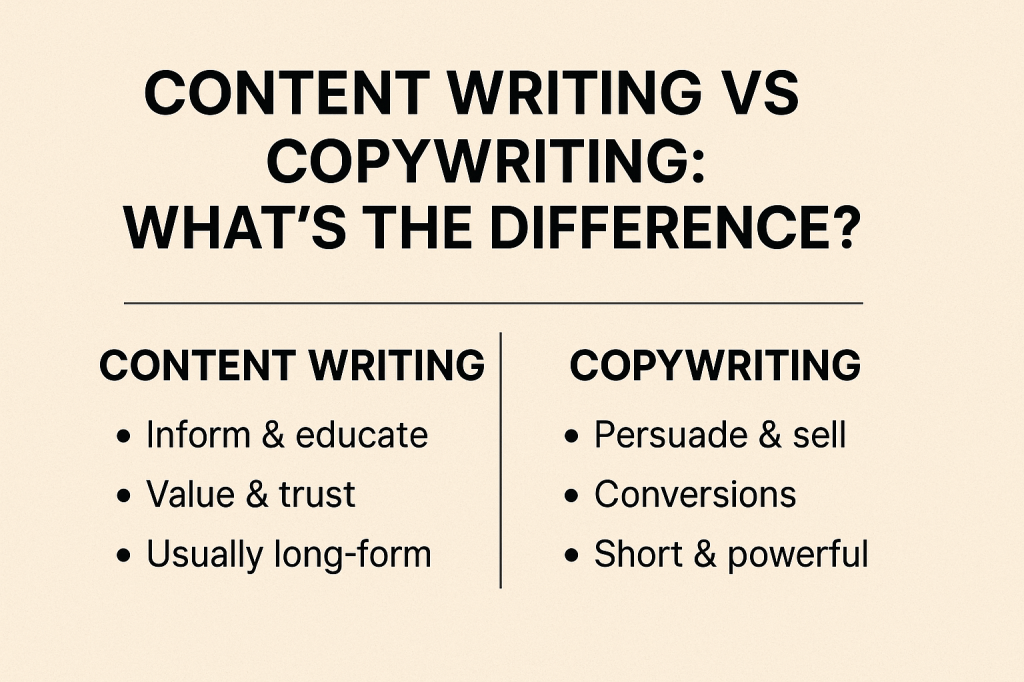
Key Differences Between Content Writing and Copywriting

Aspect

Content Writing

Copywriting

Purpose

Inform & educate

Persuade & sell

Focus

Value & trust

Conversions

SEO

Very important

Secondary

Tone

Helpful & informative

Emotional & persuasive

Length

Usually long-form

Short & powerful

Time frame

Long-term results

Immediate results

Which One Is Better for You as a Writer?

Choose content writing if you:

Enjoy teaching and explaining Like research and structure Want long-term client relationships Prefer SEO-based work

Choose copywriting if you:

Like psychology and persuasion Enjoy writing short, impactful text Want fast results and higher pay per project

Many professionals do both.

Can One Writer Do Both?

Yes—but it’s better to master one first.

Content writing builds strong foundations:

SEO skills Research ability Audience understanding

Copywriting builds:

Sales psychology Emotional triggers Conversion-focused writing

Together, they make you highly valuable.

Which One Is Better for Businesses?

Blogs and websites need content writing Ads and landing pages need copywriting

Smart brands use both.

Content writing and copywriting are different—but equally important. Knowing the difference helps you improve your skills, choose the right services, and communicate your value clearly to clients.

Whether you write to educate or to sell, clarity is power.

How to Start Freelancing With No Experience in 2025 (Beginner’s Guide)

Freelancing is one of the fastest ways to earn money online in 2025 — even if you don’t have experience yet. With the rise of remote work and digital platforms, thousands of beginners start freelancing every day and build successful careers from home.

This guide will show you exactly how to start from zero, build your skills, and get your first paying client — step by step.

How to Start Freelancing With No Experience in 2025

1. Choose a Simple Skill You Can Start With

You don’t need advanced skills.

You only need one skill that solves a small problem for someone.

Beginner-friendly freelance skills include:

Content writing Translation Social media management Data entry Virtual assistance Basic graphic design (Canva) Simple video editing Editing & proofreading Customer support Transcription

Choose one skill you enjoy and focus on it.

2. Learn the Basics (You Only Need 7–10 Days)

Don’t wait for “perfect learning.”

Just learn enough to start.

Where to learn for free:

YouTube tutorials Coursera free courses HubSpot Academy Google courses TikTok short educational videos

Your goal is only:

➡️ Know how to do the skill

➡️ Practice a little

➡️ Start offering it

3. Create a Simple Portfolio (Even Without Clients)

Many beginners think they need clients to create a portfolio — wrong.

You can create sample work to show your skill.

Examples:

Write 2–3 short blog posts Translate 2 sample paragraphs Create 3 Canva designs Edit a short video Build a small social media calendar

Upload them on:

Google Drive Canva Behance Your WordPress blog (BEST option for you)

4. Create Your Freelancer Profiles

The best beginner-friendly platforms in 2025 are:

Top platforms:

Upwork Fiverr Freelancer PeoplePerHour Khamsat (Arabic) Mostaql (Arabic)

Tips for your profile:

Use a clear photo Write a short bio about your skill Add your samples Mention your language skills Keep your pricing beginner-friendly

5. Start with Small, Easy Jobs

Your first goal is not to earn a lot of money.

Your first goal is to build experience + get good reviews.

Good starter jobs:

Short article writing Small translation tasks Data entry Social media posts Simple designs Editing emails or documents

Once you get reviews, you can increase your prices.

6. Learn How to Apply for Jobs the Right Way

Clients receive hundreds of proposals — so keep yours short and clear.

Template you can use:

Hi, I’d be happy to help with this. I have experience in (your skill) and I can deliver fast and professionally.

I already reviewed your requirements and I can start immediately.

Here are samples of my work: (link)

Looking forward to working together.

Never send long proposals — they won’t read them.

7. Be Consistent for 30 Days

If you apply daily for 30 days, you will get clients — guaranteed.

Daily tasks:

Apply for 5–10 jobs Improve your profile Post your work online Build samples every week

Freelancing rewards consistency, not perfection.

8. Deliver Great Work and Ask for a Review

This is the key to growing your income.

Happy clients = more reviews

More reviews = higher ranking

Higher ranking = higher income

After each project, politely say:

If you’re happy with the work, a short review would mean a lot.

Conclusion

Starting freelancing with no experience is absolutely possible in 2025. All you need is one small skill, a simple portfolio, and consistency. The first client is always the hardest — but once you get it, everything becomes easier.

If you start today, you can build your freelance income in weeks, not years.

Best AI Tools for Writing and Translation in 2025 (Complete Guide)

AI tools have become an essential part of the writing and translation world. They help writers, translators, and content creators save time, improve quality, and stay productive. And with so many tools available today, the real question becomes: How do you choose the right one for your work?

This guide walks you through the best AI tools in 2025, how to select the right tool for your needs, and practical steps to start using AI effectively.

Best AI tools for writing and translation in 2025

Why AI Matters in Writing Today

  1. Saves hours of work by generating drafts and organizing ideas.
  2. Helps you overcome writer’s block with quick prompts and content structure.
  3. Improves quality with rewriting, polishing, and grammar suggestions.
  4. Supports multilingual work for writers and translators handling several languages.

AI is now a partner—not a replacement—for modern writers.


Best AI Tools for Writing & Translation in 2025

1) AI Writing Tools

These tools help you:

  • Generate blog posts
  • Rewrite text
  • Create outlines
  • Produce marketing copy
  • Brainstorm ideas

Top options:

  • ChatGPT
  • Gemini
  • Jasper
  • Writesonic

2) AI Translation Tools

These tools provide fast draft translations that you can later refine.

Best choices:

  • DeepL
  • Google Translate (vastly improved in 2025)
  • AI-powered translation inside writing platforms

3) AI Editing & Proofreading Tools

Great for final polishing before publishing.

Recommended:

  • Grammarly
  • LanguageTool
  • QuillBot

How to Choose the Right AI Tool

If your goal is writing blog posts:

Choose tools that help with outlining, drafting, and rewriting.
Best fit: ChatGPT, Jasper

If your goal is translation:

Focus on meaning accuracy and natural sentence flow.
Best fit: DeepL + your manual editing

If your goal is marketing copywriting:

You need tools that produce catchy, persuasive text.
Best fit: Jasper, Writesonic

If your goal is proofreading & polishing:

Choose strong grammar and style-checking tools.
Best fit: Grammarly, LanguageTool


How to Use AI Without Losing Your Voice

  1. Always edit and personalize the text.
  2. Add your unique tone and examples.
  3. Double-check facts and statistics.
  4. Keep the structure, but rewrite the message in your style.
  5. Treat AI as a helper, not the main writer.

A Practical Step-by-Step Plan

  1. Pick one AI tool to start with.
  2. Write down your main points or outline.
  3. Ask the AI for a draft.
  4. Edit it using your own tone and experience.
  5. Add subheadings, keywords, images, and formatting.
  6. Publish and share your post.
Best AI tools for writing and translation in 2025

Conclusion

AI tools in 2025 are powerful, helpful, and time-saving. Choosing the right tool depends on your needs—whether you write articles, translate content, or polish text. With smart use and your personal touch, AI can transform your writing process and elevate your content quality.